
Summary
Choosing the wrong SEO agency can cost your business thousands of dollars and months of wasted effort. This complete 2026 guide about How to Choose an SEO Agency walks you through every critical step — from identifying your SEO goals to vetting agencies, asking the right questions, spotting red flags, and making a confident final decision. Whether you’re a startup, a growing eCommerce brand, or an enterprise business, this guide gives you a proven framework to find an agency that actually delivers results.
Table of Contents
- Why Choosing the Right SEO Agency Matters in 2026
- Define Your SEO Goals Before You Start Looking
- What to Look for in an SEO Agency
- How to Pick an SEO Agency: Step-by-Step Process
- How to Evaluate Technical SEO Expertise
- Questions to Ask Before You Hire an SEO Agency
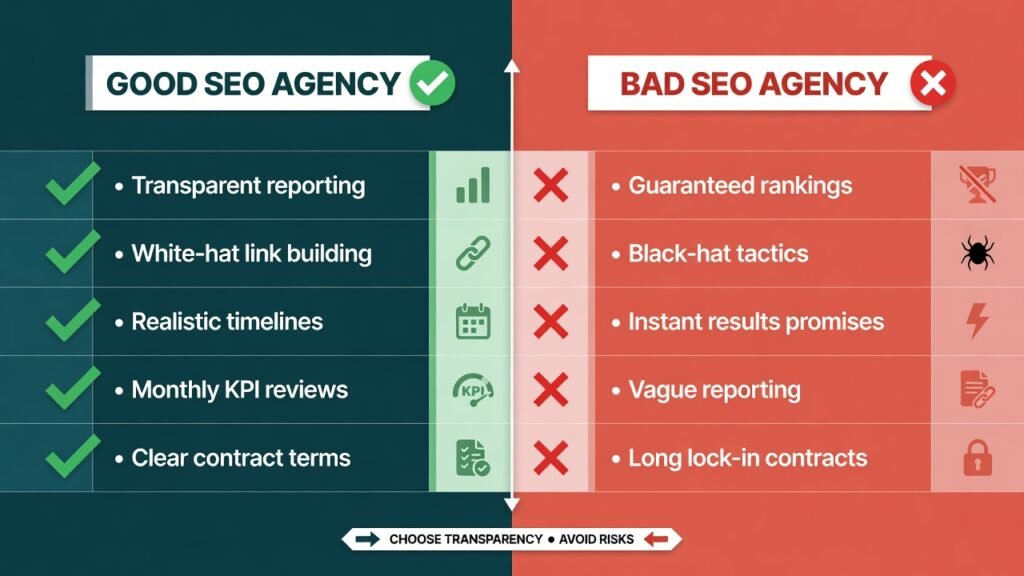
- Red Flags to Watch Out For
- Understanding SEO Pricing Models
- How to Hire an SEO Agency: Making the Final Decision
- Conclusion
1. Why Choosing the Right SEO Agency Matters in 2026
The SEO landscape in 2026 is more competitive, complex, and algorithm-driven than ever before. Google’s Search Generative Experience (SGE), AI Overviews, and Core Web Vitals updates have completely transformed how websites earn organic visibility. In this environment, the difference between a mediocre SEO agency and an exceptional one can mean the difference between ranking on page one and being invisible online.
Businesses that invest in professional SEO services generate 14.6% close rates on inbound leads compared to just 1.7% for outbound marketing. But those numbers only hold true when you’re working with the right partner — one that understands your industry, applies ethical white-hat strategies, and aligns with your growth goals.
The challenge? The SEO industry is flooded with agencies making big promises and delivering thin results. Knowing how to choose an SEO agency that is transparent, skilled, and genuinely aligned with your success is the most important decision you’ll make in your digital marketing journey.
2. Define Your SEO Goals Before You Start Looking
Before you begin evaluating agencies, you need crystal-clear internal alignment on what you actually want to achieve. Many businesses approach the agency selection process without defined KPIs (Key Performance Indicators), which leads to mismatched expectations and disappointing outcomes.
2.1 Common SEO Objectives to Clarify
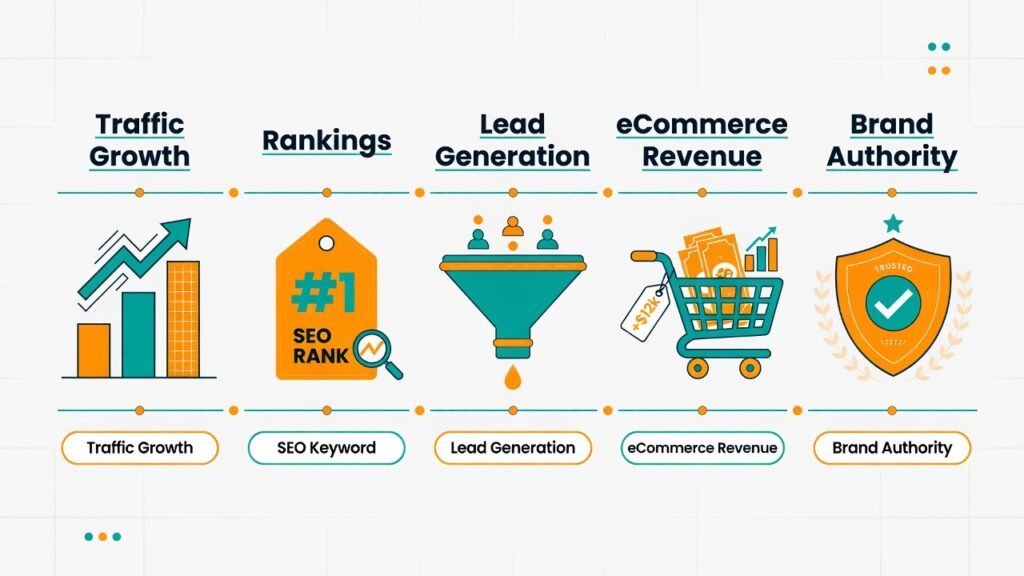
- Organic Traffic Growth: Do you want to increase monthly visitors by a specific percentage?
- Keyword Rankings: Are you targeting local, national, or global search terms?
- Lead Generation: Is the goal to convert organic traffic into qualified leads or demo requests?
- E-commerce Revenue: Are you looking to grow product page rankings and shopping conversions?
- Brand Authority: Do you want to dominate your niche with thought leadership and content?
- Technical Health: Does your website have crawlability issues, slow Core Web Vitals, or indexation problems that need fixing first?
Once you’ve defined measurable outcomes — “increase organic traffic by 40% in 12 months” or “rank in the top 3 for 10 target keywords in our city” — you’ll be far better equipped to evaluate whether a specific agency can realistically deliver on those goals.
3. What to Look for in an SEO Agency
This is the core question every business owner faces: what to look for in an SEO agency that separates the truly capable from the merely convincing. Here are the non-negotiables you should evaluate.
3.1 Proven Track Record and Case Studies
A credible SEO agency should have documented case studies — not just testimonials, but data-backed evidence of performance. Look for:
- Before/after organic traffic reports from tools like Google Search Console or Semrush
- Industry-specific results relevant to your niche
- Client retention rates (long-term clients signal consistent delivery)
- Named references or verifiable client relationships
Avoid agencies that claim confidentiality for every single case study. While some clients do request privacy, an agency with zero shareable data is a yellow flag.
3.2 Transparent Reporting and Communication
Transparency is the backbone of a healthy agency-client relationship. Your agency should provide:
- Monthly performance reports tied to agreed KPIs
- Clear explanations of what work was done each month
- Access to your own Google Analytics, Search Console, and rank tracking accounts
- A dedicated account manager who responds within 24 hours
If an agency is vague about what “SEO work” they’re doing on your account, that vagueness often hides a lack of real activity.
3.3 White-Hat SEO Methodology
In 2026, Google’s algorithms are more sophisticated than ever. Any agency still relying on black-hat or gray-hat tactics — keyword stuffing, private blog networks (PBNs), spammy link building, or cloaking — is putting your domain at serious risk of a manual penalty or algorithmic filter.
A trustworthy agency follows Google’s Webmaster Guidelines and prioritizes:
- E-E-A-T (Experience, Expertise, Authoritativeness, Trustworthiness)
- Ethical link acquisition through digital PR and outreach
- Structured data and semantic HTML implementation
- User-first content strategies that align with search intent
3.4 Full-Service SEO Capabilities
Modern SEO is not just keyword research and blog posts. A capable agency should demonstrate skills across all three SEO pillars:
- Technical SEO: Site speed optimization, crawl budget management, schema markup, Core Web Vitals
- On-Page SEO: Content optimization, internal linking strategy, metadata optimization, topic clustering
- Off-Page SEO: Link building, digital PR, brand mentions, and entity optimization
4. How to Pick an SEO Agency: Step-by-Step Process
Knowing how to pick an SEO agency efficiently saves you months of back-and-forth. Follow this structured evaluation process.
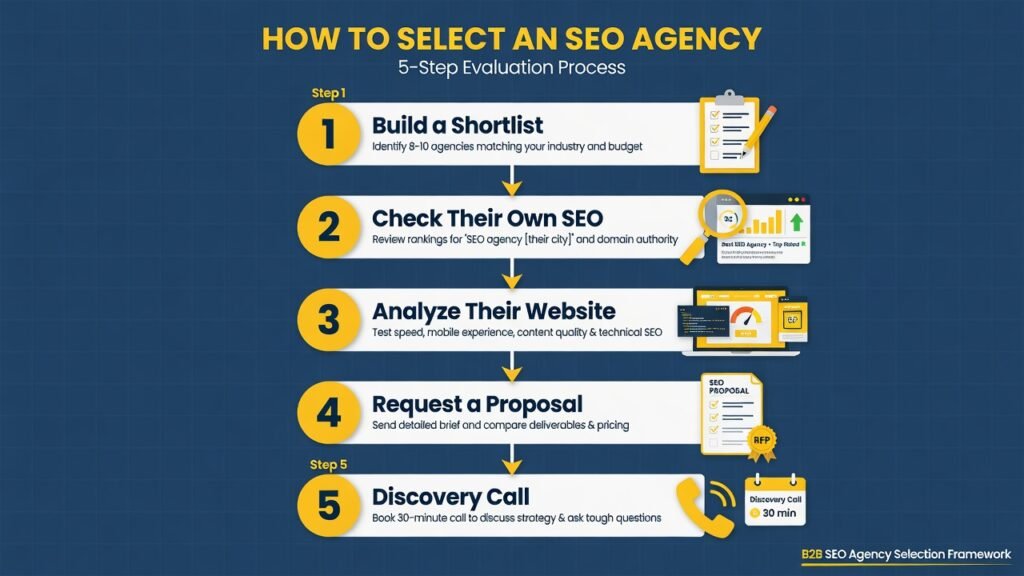
Step 1: Build a Shortlist of 4–6 Agencies
Use these sources to identify candidates:
- Google search (“best SEO agency for [your industry]”)
- Clutch.co, G2, or UpCity directories with verified reviews
- LinkedIn referrals from trusted business connections
- Industry Slack groups or forums where practitioners recommend agencies
Step 2: Review Their Own SEO Performance
It sounds obvious, but check whether the agency ranks well organically for their own target keywords. An SEO agency that can’t rank its own website is a significant credibility issue. Check their domain authority, backlink profile (via Ahrefs or Moz), and organic traffic trajectory using Semrush or Ubersuggest.
Step 3: Analyze Their Website and Content
A high-quality agency should have:
- A well-structured, fast-loading website
- Thought leadership content (in-depth blog articles, SEO guides, industry reports)
- Clear service pages that explain their methodology, not just their outcomes
Step 4: Request a Proposal or Audit
Ask each shortlisted agency for either a free technical SEO audit of your website or a custom proposal. A quality agency will provide genuine insights about your site’s current issues — not just a generic PDF full of stock screenshots.
Step 5: Conduct Discovery Calls
Schedule 30–60 minute discovery calls with your top 3 candidates. Pay attention to how they listen. Do they ask questions about your business goals, industry challenges, and current marketing stack? Or do they immediately pitch a package?
5. How to Evaluate Technical SEO Expertise
One of the most overlooked aspects of agency selection is evaluating their technical SEO capabilities. As websites become more complex — JavaScript-heavy SPAs, headless CMS platforms, Shopify Plus custom builds — technical SEO has become a specialized discipline. If your website has deep technical issues, you need to know how to choose the right technical SEO agency specifically.
5.1 Key Technical SEO Competencies to Assess
Ask agencies direct, specific questions about:
- Crawlability and Indexation: How do they approach robots.txt, XML sitemaps, and canonical tags?
- Core Web Vitals: Can they explain Largest Contentful Paint (LCP), Cumulative Layout Shift (CLS), and Interaction to Next Paint (INP)?
- JavaScript SEO: How do they handle SPAs or frameworks like React and Vue, where content is client-rendered?
- Log File Analysis: Do they use server log file analysis to identify crawl inefficiencies?
- Structured Data: Are they proficient with Schema.org markup for product pages, articles, local businesses, and FAQ sections?
5.2 Tools That Signal Technical Depth
A technically strong agency typically works with tools like:
- Screaming Frog SEO Spider
- Google Search Console (and Bing Webmaster Tools)
- DeepCrawl / Lumar
- PageSpeed Insights / Lighthouse
- Ahrefs, Semrush, or Moz Pro
If an agency’s entire toolkit consists only of Semrush and a rank tracker, they may lack the depth needed for complex technical audits.
According to Google’s official Search Central documentation, a technically sound website foundation is essential before any content or link strategy can be effectively scaled. Always verify that your chosen agency understands and respects Google’s own guidance.
6. Questions to Ask Before You Hire an SEO Agency
Asking the right questions during discovery is how you separate polished salespeople from genuine SEO practitioners. Here are the most revealing questions to ask.
6.1 Strategic Questions
- “What would be your first 30/60/90 day strategy for our website?”
- “Which competitors do you see as our biggest organic search threats, and why?”
- “How do you approach keyword research — what tools and methodologies do you use?”
- “How do you stay current with Google algorithm updates?”
6.2 Accountability Questions
- “What does your monthly reporting look like, and which KPIs will we track?”
- “Who specifically will be working on our account — and what are their backgrounds?”
- “Have you worked with a business in our industry before? Can you share results?”
- “What happens if results are below expectations in the first 6 months?”
6.3 Process and Ethics Questions
- “How do you build links? Can you walk me through your outreach process?”
- “Do you work with any competitors in our same local market or niche?”
- “What content strategy approach do you recommend for our site?”
- “What would you NOT do for our website that other agencies might try?”
The last question is particularly revealing. Confident, ethical agencies will be quick to name black-hat tactics they avoid — and explain why.
7. Red Flags to Watch Out For
Learning how to hire an SEO agency also means knowing what to walk away from. These warning signs consistently appear before bad agency experiences.
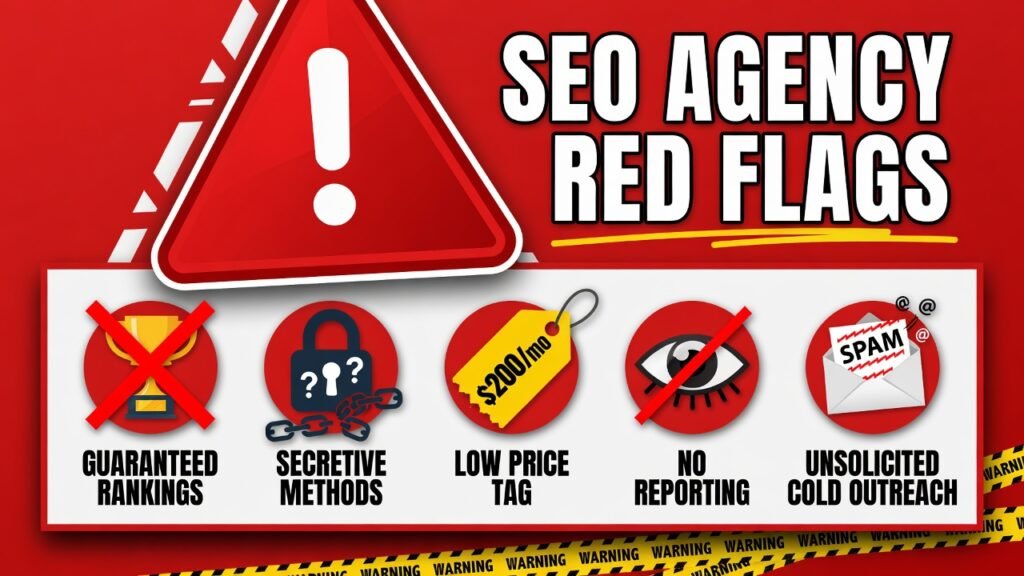
Guaranteed #1 Rankings
No agency can guarantee a #1 Google ranking. Search results are influenced by hundreds of factors — many outside any agency’s control. Any agency that promises guaranteed first-page results is either misleading you or planning to use risky tactics that could backfire.
Vague or Secretive About Their Methods
“Proprietary SEO process” is a code phrase for “we don’t want you to know what we’re doing.” Legitimate agencies explain their methodology clearly; if they won’t tell you how they’re building links or what on-page changes they’ll make, walk away.
Extremely Low Pricing
Quality SEO is a skilled, time-intensive service. Agencies charging $200–$400/month for “full-service SEO” are either cutting corners, using automation tools irresponsibly, or outsourcing to low-quality freelancers overseas. Sustainable SEO requires strategic thinking, content creation, technical expertise, and outreach — none of which can be done effectively at bargain rates.
No Reporting or Data Access
If an agency refuses to share login access to your Google Search Console or Analytics accounts, or only provides branded PDF reports without raw data, that’s a major red flag. You should always own and have access to your own data.
They Contact You Out of the Blue Claiming Your Site Has Problems
Unsolicited cold emails saying “I found critical SEO errors on your website” are almost always scams or low-quality operations using automated crawl tools. Reputable agencies don’t typically need to cold prospect in this manner.
8. Understanding SEO Pricing Models
One of the most common points of confusion when businesses learn how to choose an SEO agency is pricing. SEO services are priced in several different ways, and understanding the structure helps you compare agencies fairly.
8.1 Monthly Retainer (Most Common)
A fixed monthly fee for ongoing SEO services. Typically ranges from:
- $750–$2,000/month: Small businesses, local SEO, early-stage startups
- $2,000–$6,000/month: Growing businesses, regional or national SEO
- $6,000–$20,000+/month: Enterprise-level, competitive industries, multi-location businesses
The retainer model works best for long-term partnerships where strategy, content, and link building are continuously executed month over month.
8.2 Project-Based Pricing
Fixed pricing for a defined deliverable — typically a technical SEO audit, site migration support, or a content strategy blueprint. Useful when you need a specific problem solved, not ongoing management.
8.3 Hourly Consulting
Some SEO specialists and boutique agencies charge hourly rates ($100–$400/hour) for strategy, consulting, or training. Best suited for in-house teams that need expert guidance without full management.
8.4 Performance-Based SEO
A newer model where you pay based on results — usually a share of revenue generated or a fee per page that reaches a target ranking. Be cautious: this model can incentivize short-term tactics over sustainable strategy.
When evaluating pricing, always ask: What’s included each month? How many hours? What deliverables will you receive? Transparency in scope prevents billing surprises.
9. How to Hire an SEO Agency: Making the Final Decision
You’ve shortlisted your candidates, asked the hard questions, reviewed their proposals, and assessed their red flag risk. Now it’s time to make a confident, informed decision.
9.1 Score Each Agency on a Weighted Matrix
Create a simple decision matrix with these criteria (score 1–5 for each):
| Criteria | Weight |
| Relevant industry experience | High |
| Technical SEO capabilities | High |
| Reporting transparency | High |
| Content strategy approach | Medium |
| Communication & responsiveness | Medium |
| Pricing vs. deliverables value | Medium |
| Client references and reviews | High |
Multiply each score by the weight and total the results. This removes emotion from the decision.
9.2 Start With a Pilot Project or Short Contract
If you’re uncertain between two top candidates, propose a 3-month pilot engagement before committing to a 12-month contract. A good agency will welcome this — it’s an opportunity for them to prove their value.
9.3 Review the Contract Carefully
Before signing, ensure the contract specifies:
- Ownership of all deliverables (content, links built to your site, data)
- Month-to-month exit clause or reasonable notice period (30–60 days)
- No lock-in clauses that prevent you from working with others
- Clear scope of work with hours or deliverables defined
If an agency insists on a 12-month locked contract with no performance clause, negotiate or move on.
9.4 Align on Timelines and Expectations
SEO is a long-term investment. Realistic results timelines:
- Months 1–2: Technical audit, onboarding, strategy development
- Months 3–4: On-page optimization, content publication begins, initial quick wins
- Months 5–6: Link building momentum builds, rankings start shifting
- Months 6–12: Organic traffic growth becomes measurable and consistent
Any agency promising significant traffic growth in 30 days is misleading you about how search engines work.
If you’re ready to partner with a team that prioritizes long-term, sustainable organic growth, consider working with a Result driven SEO Agency that has a proven methodology for delivering measurable results across competitive markets.
Still unsure whether SEO is right for your business stage? Read our detailed guide on why hire an SEO agency to understand the full business case before making your final decision.
10. Conclusion
Choosing the right SEO agency is one of the highest-leverage decisions you can make for your business’s digital growth. The wrong choice wastes your budget, risks your domain authority, and sets you back months. The right choice compounds over time — building lasting rankings, authority, and a predictable stream of organic leads and revenue.
To summarize the key principles from this guide:
- Define your SEO goals and KPIs before speaking to any agency
- Evaluate agencies on track record, transparency, ethics, and technical depth
- Ask hard questions and watch for red flags like guaranteed rankings and secretive methods
- Understand pricing models and always clarify the scope before signing
- Start with a pilot project if you’re uncertain, and always maintain ownership of your data
The SEO agency you choose in 2026 should feel less like a vendor and more like a strategic partner invested in your long-term growth. Take the time to choose wisely — the organic traffic results you build over the next 12 to 24 months will become one of your most valuable business assets.