Summary
Search engine optimization is no longer optional for businesses that want to grow online. But the real question most business owners wrestle with is this: do I need an SEO agency, or can I handle it myself? This comprehensive guide breaks down exactly why hiring an SEO agency makes sense for many businesses, what measurable ROI looks like, when it’s truly worth the investment — and when it honestly isn’t. Whether you’re a startup founder, a mid-market marketing manager, or an e-commerce brand owner, this article will help you make a confident, data-driven decision.
Table of Contents
- What Is an SEO Agency — A Quick Recap
- The State of Organic Search in 2025
- Why Hire an SEO Agency? Core Benefits
- Do I Need an SEO Agency? 7 Signs the Answer Is Yes
- What to Expect from an SEO Agency
- The ROI of Hiring an SEO Agency
- When Hiring an SEO Agency Is NOT Worth It
- How to Choose the Right SEO Agency
- Conclusion
1. What Is an SEO Agency — A Quick Recap
Before diving deep into the decision-making process, it helps to be clear on what you’re actually buying. If you want a thorough breakdown, read our guide on What Is an SEO Agency — but here’s the short version.
An SEO agency is a team of specialists dedicated to improving your website’s visibility in organic (unpaid) search results on platforms like Google, Bing, and other search engines. They work across multiple disciplines — technical SEO, on-page optimization, content strategy, link building, local SEO, and performance analytics — to help your site rank higher for the search queries your ideal customers are already typing.
Unlike a generalist marketing agency, an SEO Agency focuses exclusively on building and sustaining long-term organic traffic that compounds over time.
2. The State of Organic Search in 2025
Organic Search Is Still the Dominant Traffic Channel
According to BrightEdge research, organic search drives over 53% of all website traffic across industries — more than paid search, social media, and direct traffic combined. Despite the emergence of AI-generated answers, zero-click searches, and featured snippets, ranking on the first page of Google remains one of the most powerful and cost-efficient ways to reach potential customers at the exact moment of intent.
Google’s Algorithm Is More Complex Than Ever
With over 200 confirmed ranking factors and updates like Core Web Vitals, Helpful Content, and E-E-A-T (Experience, Expertise, Authoritativeness, Trustworthiness), staying ahead of Google’s algorithm has become a specialized discipline. The days of stuffing keywords into a page and hoping for results are long gone. Modern SEO requires:
- Deep technical website auditing
- Semantic content architecture
- Authoritative backlink profile building
- User experience optimization
- Structured data and schema markup implementation
This complexity is precisely why the question of why to hire an SEO agency has become increasingly relevant for businesses of all sizes.
3. Why Hire an SEO Agency? Core Benefits
Access to a Full Team of Specialists
When you hire an SEO agency, you’re not getting one person — you’re getting an entire team. A reputable agency brings together technical SEO analysts, content strategists, link-building specialists, UX consultants, and data analysts under one roof. For the cost of hiring a single in-house SEO manager, you gain access to a multi-disciplinary team with layered expertise.
Proven Frameworks and Proprietary Tools
Top SEO agencies invest in enterprise-grade tools like Ahrefs, SEMrush, Screaming Frog, Moz Pro, SurferSEO, and Clearscope — platforms that cost thousands of dollars per month. Beyond tools, agencies have developed proprietary frameworks and battle-tested workflows refined across dozens of client campaigns in various industries and competitive landscapes.
Faster Results Through Established Processes
An experienced agency has already made the mistakes, learned what works, and built repeatable systems. Rather than spending months experimenting with your website, they can deploy proven strategies from day one — helping you avoid common SEO pitfalls that could result in Google penalties or wasted budget.
Scalability Without Hiring Headaches
As your business grows, so do your SEO needs. An agency scales with you. Need to launch in three new geographic markets? Expand your keyword footprint? Recover from an algorithm penalty? Agencies can spin up resources and expertise on demand — something an in-house team would struggle to match without expensive hiring cycles.
Objective, Outside Perspective
In-house teams are often too close to the product and brand to spot opportunities or problems with fresh eyes. An external SEO agency brings objectivity — they look at your website the same way Google does, identifying blind spots in your content, site architecture, and competitive positioning that internal teams routinely miss.
4. Do I Need an SEO Agency? 7 Signs the Answer Is Yes
Not every business needs an agency at every stage. But if you’re asking yourself do I need an SEO agency, here are seven clear indicators that the answer is yes:
Sign #1: Your Website Gets Little to No Organic Traffic
If Google Analytics shows that fewer than 10–15% of your sessions come from organic search, you have a serious visibility problem. An agency can identify whether the issue is technical (crawlability, indexation), content-based (thin or irrelevant pages), or authority-related (weak backlink profile) — and build a roadmap to fix it.
Sign #2: You’re Losing Ground to Competitors
Run a competitive analysis. If your main competitors dominate the first page of Google for your core keywords and you’re nowhere to be found, you’re losing customers every single day. An SEO agency can perform a competitor gap analysis to identify exactly where they’re winning and how to close that gap.
Sign #3: Your In-House Team Lacks SEO Expertise
Marketing generalists are valuable, but SEO is a specialized, rapidly evolving field. If your team doesn’t have dedicated SEO expertise, you’re likely leaving significant organic traffic on the table — and possibly making technical mistakes that actively harm your rankings.
Sign #4: You’ve Recently Launched a New Website or Rebranded
Website migrations and relaunches are among the most SEO-dangerous events a business can go through. If handled incorrectly, they can cause dramatic ranking drops, broken redirects, and loss of domain authority. An agency’s involvement during and after a migration is critical to protecting existing rankings.
Sign #5: You Operate in a Competitive or Regulated Industry
Industries like legal, financial services, healthcare, SaaS, and e-commerce are highly competitive in organic search. Ranking in these verticals requires sophisticated content strategies, strong E-E-A-T signals, and aggressive link-building campaigns that most in-house teams simply cannot execute alone.
Sign #6: You’re Running Paid Ads Without an Organic Strategy
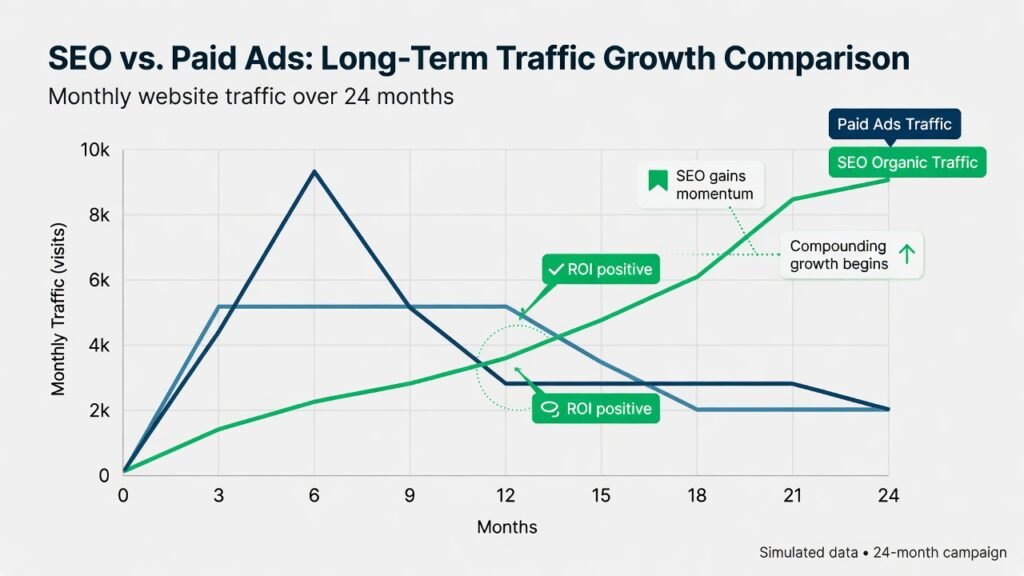
Paid search (PPC) provides immediate visibility but is expensive and stops the moment you cut the budget. If you’re spending heavily on Google Ads without building complementary organic assets, you’re renting visibility instead of owning it. An SEO agency helps you build sustainable traffic that doesn’t depend on ad spend.
Sign #7: You Don’t Have Time to Keep Up with Algorithm Changes
Google rolled out dozens of core algorithm updates in 2024 alone. Keeping pace with changes to ranking signals, search intent shifts, and emerging SERP features (like AI Overviews) is essentially a full-time job. Agencies dedicate resources to monitoring and adapting to these changes so your rankings don’t quietly erode.
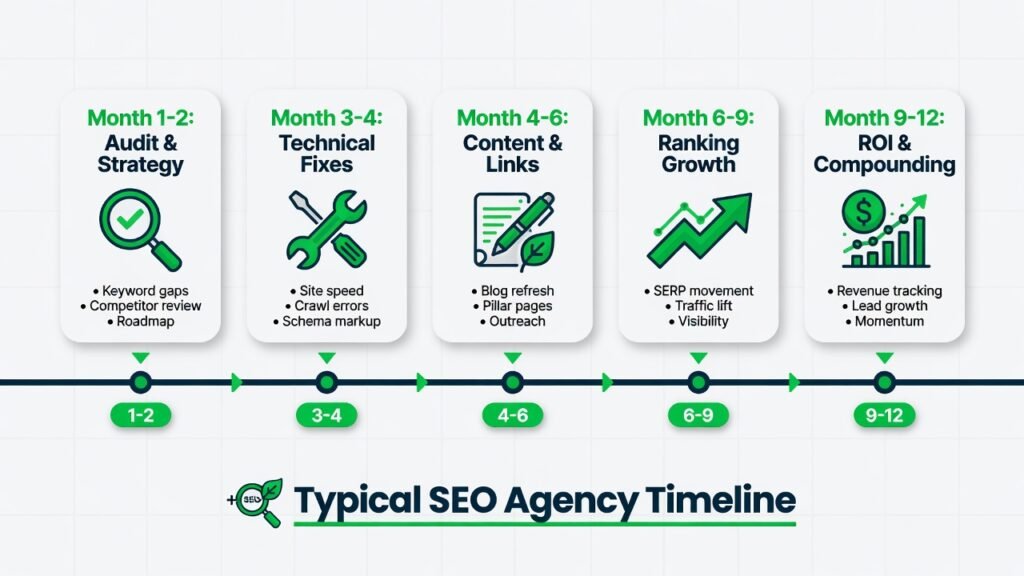
5. What to Expect from an SEO Agency
Understanding what to expect from an SEO agency upfront prevents disappointment and sets the foundation for a productive partnership. Here’s a realistic breakdown:
Month 1–2: Discovery, Audit, and Strategy
In the onboarding phase, expect a deep-dive technical SEO audit, competitor analysis, keyword research, and content gap assessment. The agency will document its findings and present a prioritized roadmap. This phase is foundational — don’t rush it.
Month 3–6: Implementation and Early Wins
Technical fixes go live. On-page optimization begins. Content production ramps up. You may start to see early ranking improvements and modest traffic growth for lower-competition keywords. Link-building outreach begins by building your domain authority.
Month 6–12: Compounding Growth
Organic search is not a switch — it’s a compounding asset. By months six to twelve, with consistent execution, most businesses see meaningful improvements in keyword rankings, organic sessions, and qualified lead flow. High-authority backlinks secured during months three to six begin to pass significant ranking power.
Ongoing: Optimization, Reporting, and Iteration
A good agency doesn’t set and forget. Expect monthly reporting with clear KPIs — keyword ranking movements, organic traffic growth, conversion rates from organic search, and ROI metrics. Regular strategy calls ensure alignment with your evolving business goals.
What You Should NOT Expect
- Overnight results. SEO is a medium-to-long-term investment. Be suspicious of any agency that promises page-one rankings in 30 days.
- Guaranteed rankings. No agency can guarantee specific Google positions. Algorithm changes and competitor activity are outside anyone’s control.
- Passive involvement from you. The best outcomes happen when clients actively collaborate — sharing brand voice, product knowledge, and business priorities.
6. The ROI of Hiring an SEO Agency
How to Measure SEO Return on Investment
ROI is the deciding factor for most business owners weighing whether to hire an SEO agency. Unlike paid advertising, SEO ROI compounds over time and is measured across several dimensions:
Traffic Value: Tools like Ahrefs calculate the equivalent cost to generate your organic traffic through paid ads. A website generating 10,000 monthly organic sessions might represent $25,000–$100,000+ in equivalent PPC spend, depending on the industry and keyword competition.
Lead and Revenue Attribution: Google Analytics 4, combined with CRM data, allows businesses to directly attribute revenue to organic search channels — making it possible to calculate exact cost-per-acquisition from SEO.
Customer Lifetime Value (CLV) Multiplier: Organic search visitors often exhibit higher purchase intent and lower bounce rates than other channels, translating to better CLV. This makes the true ROI of SEO even greater than surface-level metrics suggest.
Real-World ROI Benchmarks
According to Search Engine Journal and HubSpot research, companies that invest in SEO consistently report some of the strongest marketing ROI across channels. B2B companies typically see an organic search ROI of 300–500% over a 12–24 month horizon. E-commerce brands with strong product SEO often report even higher returns due to high purchase intent search queries converting directly to sales.
The math becomes compelling quickly: if an agency retains you at $3,000–$5,000/month and generates $20,000 in incremental monthly revenue within 12 months, your ROI is substantial — and that revenue continues without increasing spend.
The Cost of NOT Investing in SEO
Every month your website sits without a coherent SEO strategy is a month your competitors are building domain authority, capturing keyword rankings, and earning backlinks you’ll later have to outcompete. The compounding nature of SEO means that delay has an exponential cost — not just a linear one.
7. When Hiring an SEO Agency Is NOT Worth It
Honesty matters here. There are genuine scenarios where the cost and timeline of an SEO agency may not be the right fit:
Very Early-Stage Startups Without Product-Market Fit
If you’re still testing your business model, pivoting frequently, or haven’t validated your core offering, investing in SEO may be premature. SEO builds on stable site architecture and consistent messaging — frequent pivots undo that work.
Hyper-Local Businesses with Minimal Online Competition
A local plumber in a small rural town may not need a full-service SEO agency. A well-optimized Google Business Profile, a handful of local citations, and a clean website might be sufficient — tasks achievable without agency support.
Businesses Needing Immediate Revenue Now
If your business desperately needs revenue in the next 30–60 days, SEO is the wrong lever to pull first. Paid advertising, outbound sales, or conversion rate optimization will deliver faster cash flow. SEO should layer on as a long-term asset once there is runway to invest.
Businesses Without a Content Budget
SEO and content are inseparable. If your organization cannot allocate budget and resources toward ongoing content creation — blog posts, landing pages, case studies, guides — an SEO agency will struggle to produce meaningful results, since content is the primary vehicle for ranking.
8. How to Choose the Right SEO Agency
If you’ve determined that yes, it’s time to bring in an agency, here’s what separates elite agencies from mediocre ones:
Look for Transparent Reporting and Clear KPIs
Any reputable agency should be able to clearly define what success looks like, with measurable KPIs tied to your business goals — not vanity metrics like “DA improvements” or “keyword volume.”
Evaluate Their Own SEO Performance
The most credible agencies rank well for their own target keywords. If an SEO company can’t get itself to rank, that’s a red flag worth taking seriously.
Demand Case Studies and Vertical Experience
Ask for case studies in your industry or for comparable business models. The tactics that work for a B2B SaaS company differ dramatically from those needed by a local service business or an e-commerce retailer.
Beware of Black-Hat Promises
Any agency promising instant rankings, guaranteed top-three positions, or “secret techniques” is likely using manipulative tactics — private blog networks (PBNs), link farms, keyword stuffing — that may produce short-term lifts followed by Google penalties that can take months or years to recover from.
Assess Communication and Cultural Fit
SEO is a long-term relationship. You want an agency that communicates proactively, explains their work in plain language, and genuinely understands your business goals — not one that hides behind jargon and sends automated monthly PDF reports.
For additional guidance from one of the leading voices in the industry, Moz’s Beginner’s Guide to SEO is an authoritative resource that can help you ask the right questions when evaluating potential agency partners.
Conclusion
The question of why hire an SEO agency ultimately comes down to this: organic search is one of the most powerful, cost-efficient, and compounding marketing channels available — but only when executed with expertise, consistency, and strategic depth. For most growing businesses operating in competitive markets, a professional SEO agency is not a luxury; it’s a strategic investment in long-term sustainable growth.
If your website isn’t generating the organic traffic your business deserves, if competitors are outranking you, or if your in-house team simply doesn’t have the specialized expertise to compete, the right SEO agency can be transformative.
The key is choosing a partner who prioritizes transparency, measurable results, and alignment with your actual business goals. Avoid agencies that overpromise, use manipulative tactics, or keep you in the dark about what they’re actually doing.
When you find the right fit, the compounding returns from organic search — month after month, year after year — make hiring an SEO agency one of the highest-ROI marketing decisions a business can make.